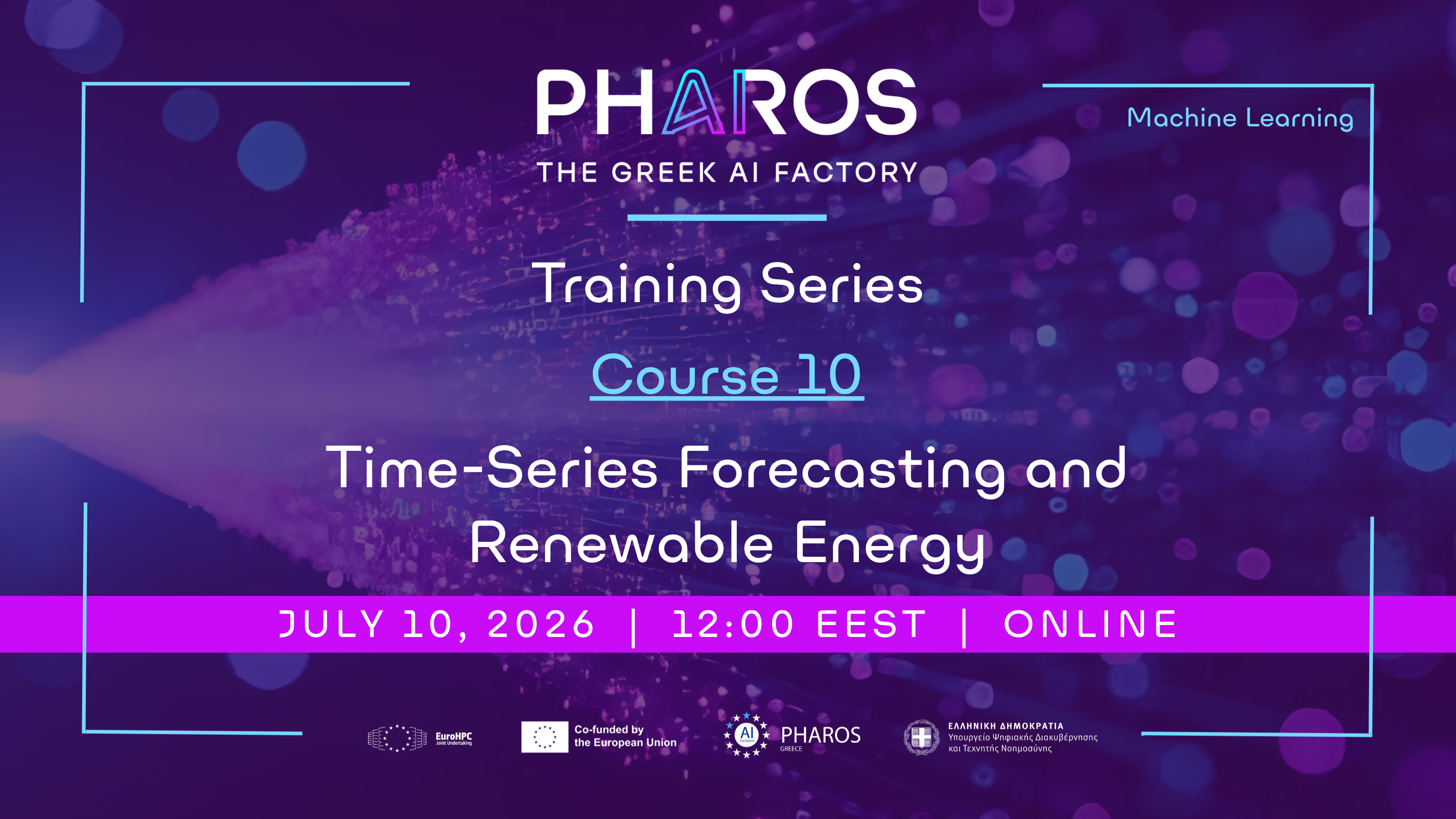
PHAROS Training Series - Course 10 "Time-Series Forecasting and Renewable Energy"

Europe/Athens
Description

PHAROS AI Factory announces the 10th Course of its Training Series, under the title "Time-Series Forecasting and Renewable Energy", under the topic Machine Learning, held online via Zoom.

Date: July 10th, 2026, at 12:00 EEST 

Location: Online via Zoom

Presentation Language: Greek

AudienceML Engineers, AI Engineers, Data Scientists, Academic Researchers

PrerequisitesMachine learning, Python

Learning Objectives

- Develop and evaluate Machine Learning models for day-ahead solar energy production forecasting. 
- Interpret forecasting results using appropriate performance metrics and validation techniques. 
- Understand the role of accurate renewable energy forecasting in electricity markets and energy system operations. 
- Describe how renewable energy aggregators use forecasting to support market participation and grid stability. 
- Recognize the importance of effective data visualization and user interfaces for communicating forecasting results. 
- Apply best practices for designing end-to-end forecasting pipelines, from data collection to model deployment.

Instructors' profiles:

  • Ioannis Vlahavas, AUTH

Ioannis Vlahavas is a professor at the Department of Informatics at the Aristotle University of Thessaloniki. He received his Ph.D. degree in Logic Programming Systems from the same University in 1988. He has been a visiting scholar at the Department of CS at Purdue University and in 2017 elected EurAI Fellow from the European Association for Artificial Intelligence. He specializes in knowledge based and AI (machine learning) systems and he has published more than 400 papers and book chapters and co-authored 9 books in these areas. Google scholar gives a number exceeding 21600 citations and an h-index of 60. He has successfully supervised 19 PhD students, and he has been involved in more than 50 research and development projects, leading most of them. He was Chairman of the school of Informatics at the Aristotle University (2013-2017), member of the steering committee and Dean of the School of Science and Technology of the International Hellenic University (2007-2016) and member of the Sectoral Scientific Council in Artificial Intelligence (2025-today). He is currently leading the Intelligent Systems Lab

Details in https://intelligence.csd.auth.gr/people/vlahavas/

Linkedin: https://www.linkedin.com/in/ioannis-vlahavas/

  • Vasileios Kochliaridis, AUTH

Vasileios Kochliaridis graduated with a degree in Computer Engineering and Information Technology from the University of Ioannina, and since 2021 has been a member of the Intelligent Systems Lab (ISL) and a Ph.D. candidate in the field of Artificial Intelligence under the supervision of Professor Vlachava. The focus of his doctoral research is the development of intelligent agents for autonomous systems, with a particular emphasis on financial data, as well as on autonomous and intelligent systems. During his doctoral studies, he has gained both technological and academic experience through research projects and publications. In the technological field, he has successfully contributed in the role of data scientist and deep learning researcher. Since 2022, he has been the lead researcher in the development of a tool for time series forecasting and the generation of synthetic data  for financial metrics, as well as urban environment data and images, using GAN networks to train agents for the navigation of autonomous vehicles within a simulation.

More information on his page: https://intelligence.csd.auth.gr/vasileios-kochliaridis-phd-student/

  • Anestis Ampatzidis, EY & AUTH

Anestis is an AI Consultant at EY and an Artificial Intelligence Researcher at the Intelligent Systems Laboratory. He holds a Bachelor's degree in Computer Science and a Master's degree in Data and Web Science from the Aristotle University of Thessaloniki, with excellent academic performance. His expertise focuses on the development of integrated Artificial Intelligence systems for the energy sector. He has extensive research and professional experience in time series forecasting, for both energy production and demand, utilizing advanced Machine Learning models. Additionally, he has a strong background as a Machine Learning Engineer, focusing on transforming models into comprehensive end-to-end solutions. He designs scalable cloud infrastructures and ensures the seamless integration of algorithms into production systems, delivering reliable real-time predictions.

LinkedIn: linkedin.com/in/anestis-ampatzidis-a04415301 

Note: Please enter your institutional/corporate email when registering.


Registration
Registration
    • 12:00 12:10
      Introduction & Objectives 10m
      Speaker: Ioannis Vlahavas (AUTH)
    • 12:10 12:40
      Concepts of Machine Learning & Deep Learning 30m

      This topic introduces concepts of Machine Learning and Deep Learning, with a focus on time-series forecasting. The talk explains how systems can learn patterns from data and make predictions without relying on explicit programming. It then focuses on Deep Learning, which can model complex relationships in large datasets, with a special emphasis on forecasting models for time-series data. The webinar covers modern deep learning methods, including LSTMs, GRUs, Temporal Convolutional Networks and Transformers. Participants will gain a clear overview of how these models are used in real-world applications such as finance and energy.

      Speaker: Vasileios Kochliaridis (AUTH)
    • 12:40 13:10
      Forecasting Renewable Energy Production Using Machine Learning 30m

      This presentation focuses on Day-Ahead forecasting of solar energy production, showcasing a practical application of Machine Learning in renewable energy. The discussion covers the complete data pipeline, detailing how meteorological and historical records are processed to train predictive ML models, particularly Neural Networks. Additionally, the role of Aggregators (FOSE) in the modern energy market is examined to emphasize the real-world value of accurate forecasting. Finally, the design of an intuitive User Interface (UI) tailored for visualizing these predictions is presented, offering a complete perspective from raw data to the final end-user experience.

      Speaker: Anestis Ampatzidis (EY & AUTH)