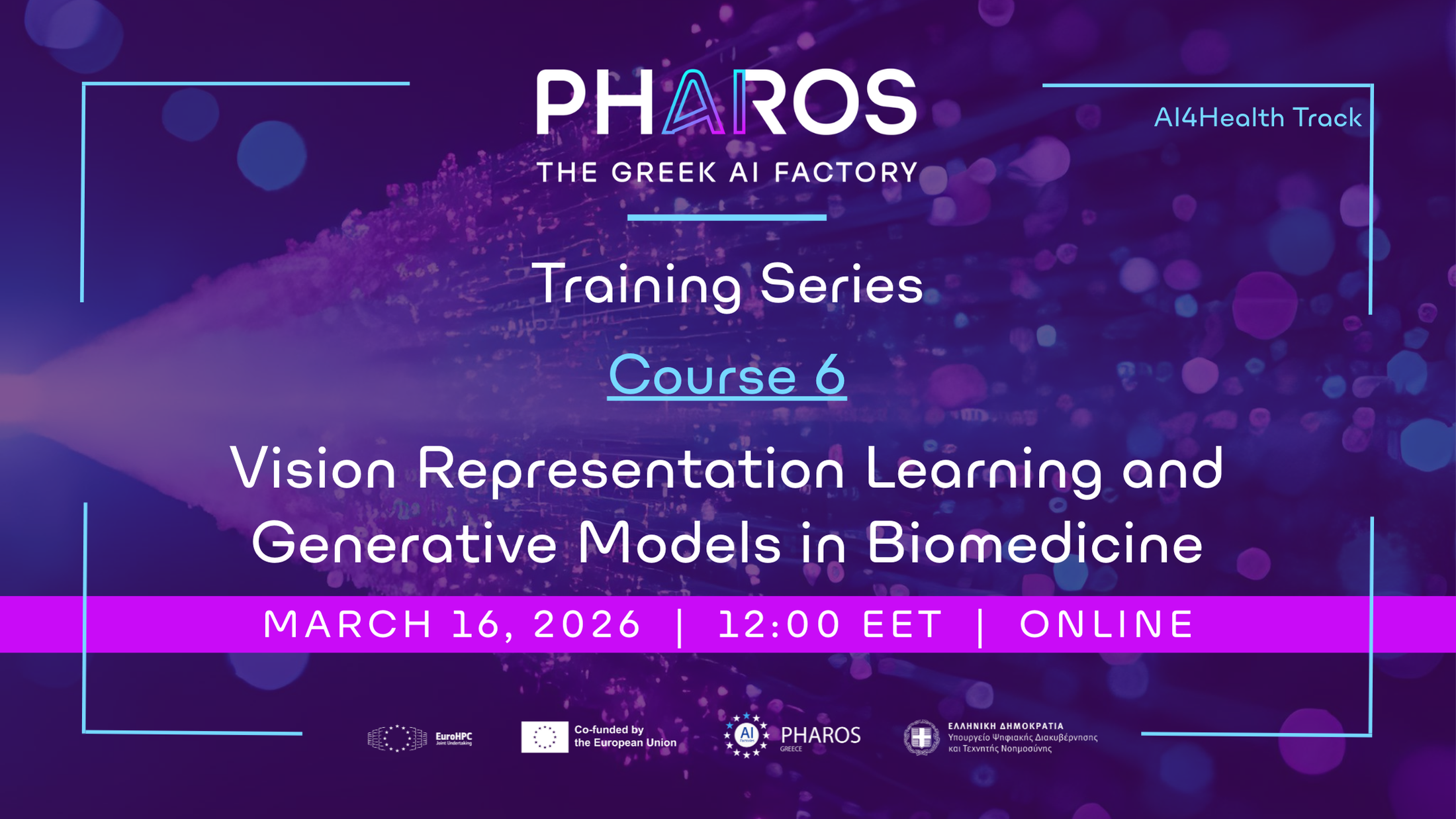
PHAROS AI Factory announces the 6th Course of its Training Series, under the title "Vision Representation Learning and Generative Models in Biomedicine", under the Specialisation AI4Health.
Date: March 16th, 2026, at 12:00 EET
Location: Online via Zoom
Presentation Language: Greek
Description: The course focuses on state-of-the-art machine learning techniques for extracting and modeling information from biomedical images. The course introduces how deep neural networks learn visual representations that enable robust performance in tasks such as classification, segmentation, and anomaly detection in medical and biological imaging.
The first part of the webinar covers vision representation learning, emphasizing convolutional neural networks, transfer learning, and self-supervised and contrastive learning methods. Participants will learn how representations can be learned from large-scale unlabeled biomedical datasets and adapted to downstream tasks where labeled data is scarce. Real-world examples from histopathology and medical imaging will be discussed to illustrate best practices and common challenges.
The second part of the webinar introduces generative models, including Variational Autoencoders (VAEs) and Generative Adversarial Networks (GANs). These models are examined in the context of biomedical applications such as data augmentation, image synthesis, latent space interpretation, and hypothesis generation. The session highlights how generative modeling can support both predictive performance and scientific discovery by capturing the underlying structure of complex biological data.
The webinar combines theory, visual demonstrations, and interactive discussions to provide participants with a practical understanding of how representation learning and generative models are applied in modern biomedical AI pipelines.
Audience:
- Data Scientists and Machine Learning Engineers
- Biomedical and Computational Researchers
- PhD and MSc students in AI, Biomedical Engineering, or Computer Vision
- Professionals in medical technology, digital health, and life sciences
Learning Objectives:
By the end of the course, participants will:
- Gain a deeper understanding of vision representation learning techniques in biomedicine
- Understand the role of generative models in biomedical image analysis
- Learn how modern deep learning architectures are applied to medical and biological data
- Engage with practical examples and case studies drawn from real-world research
Learning Outcomes:
After completing the course, participants will be able to:
- Explain core principles of representation learning and generative modeling
- Analyze biomedical imaging problems and select appropriate modeling approaches
- Evaluate when and how generative models can be applied in biomedical projects
- Identify next steps for further research or implementation in professional settings
Instructors' profiles:
Grigorios Kalliatakis is a collaborating researcher at Computational BioMedicine Laboratory (CBML) of Institute of Computer Science, Foundation for Research and Technology - Hellas (FORTH). His research interests are in the areas of computer vision, deep learning, unsupervised learning, and representation learning, focusing on applications to healthcare. He has participated in large-scale UK research projects (ESRC and Cancer Research UK) as well as EU-funded projects. He has authored more than 20 publications in high profile journals and conferences (Radiology, CVPR, ICCV).
Prerequisites: Basic understanding of Deep Learning.
Note: Please enter your institutional/corporate email when registering.