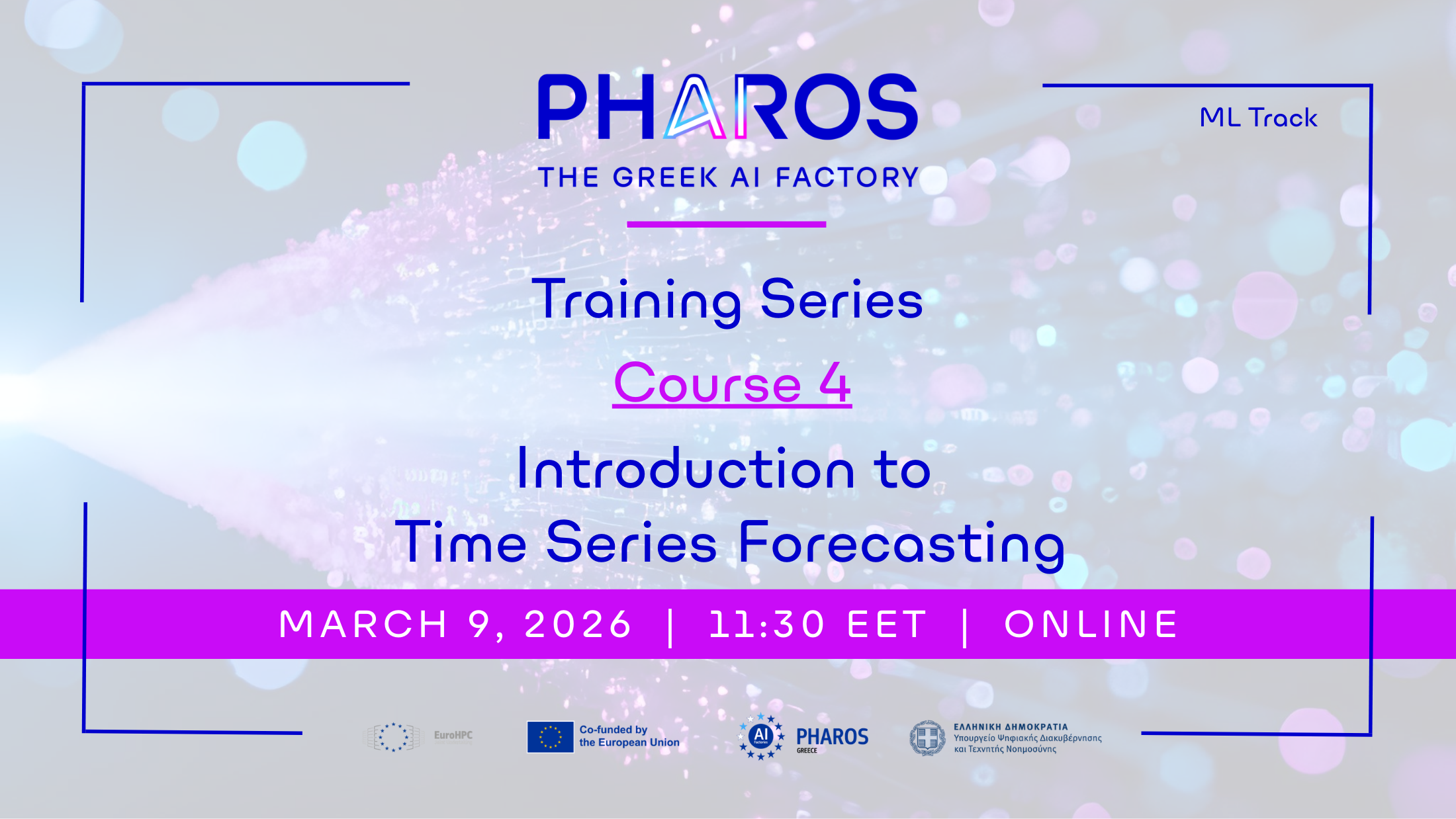
PHAROS AI Factory announces the 4th Course of its Training Series, under the title "Introduction to Time Series Forecasting", Track "Machine Learning", held online via Zoom.
Date: March 9th, 2026, at 11:30 EET
Location: Online via Zoom
Presentation Language: Greek
Audience: This course is intended for postgraduate students in computer science and economics, researchers, employees of small and medium-sized enterprises (SMEs), data scientists, and machine learning engineers, as well as anyone interested in applying time series forecasting techniques to real-world, data-driven problems.
Course Description:
This course provides a complete, hands-on introduction to time series forecasting, starting from the fundamentals of what time series data is and why its analysis is essential. Participants will learn why forecasting plays a critical role in decision making, how data analysis and preprocessing are integrated into the forecasting pipeline, and how insights are extracted from temporal data. The session covers classical statistical models for time series forecasting. Through practical, end-to-end examples, attendees will implement forecasting models, gain a solid understanding of the underlying theory, and apply these techniques to real-world scenarios.
Learning Objectives:
This course provides a complete, hands-on introduction to time series forecasting, starting from the fundamentals of what time series data is and why its analysis is essential. Participants will learn why forecasting plays a critical role in decision making, how data analysis and preprocessing are integrated into the forecasting pipeline, and how insights are extracted from temporal data. The session covers both classical statistical models and modern machine learning and deep learning approaches for time series forecasting. Through practical, end-to-end examples, attendees will implement forecasting models, understand the theory behind them, and apply these techniques to real-world scenarios.
Learning Outcomes: Solve a specific problem
Upon successful completion of this course, participants will be able to systematically handle time series data, applying appropriate analytical tools and methodologies to address real-world forecasting challenges. They will develop a structured analytical mindset, understanding the end-to-end forecasting pipeline—from problem definition and data preprocessing to model selection, evaluation, and interpretation of results—while being able to identify patterns, trends, and seasonality within temporal data.
Instructor's profile:
Efterpi Paraskevoulakou is a Research Assistant and PhD Candidate at the University of Piraeus, specializing in AI-driven orchestration and optimization of Cloud–Edge Continuum applications. Her research focuses on intelligent resource allocation, infrastructure optimization, and time-series–based predictive analytics for large-scale distributed environments. Her publications include studies on Dynamic Resource Allocation on the Edge and Machine Learning Functions as a Service, contributing to intelligent orchestration frameworks that integrate AI, optimization, and time-series forecasting for next-generation computing continuum environments.
Prerequisites: Participants should have intermediate-level knowledge of the Python programming language and a basic understanding of data analysis concepts.
Note: Please enter your institutional/corporate email when registering.