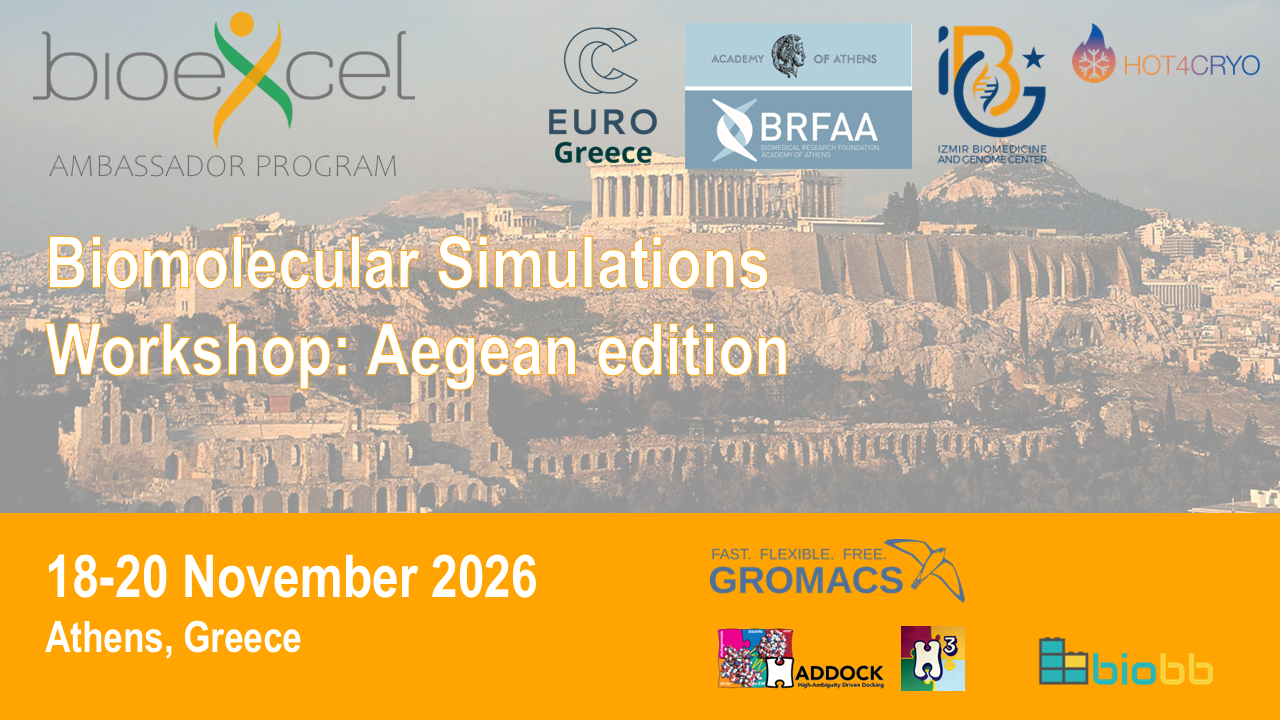
BioExcel / EuroCC workshop on Biomolecular Simulations: Aegean Edition
Date: November 18-20, 2026
Location: Biomedical Research Foundation of the Academy of Athens (BRFAA)
Type of the event: Hybrid (30 on-site + 10 online participants)
Presentation Language: English
Audience: Suitable for graduate students, postdocs, PIs
Participation criteria: Open application with a selection. 30 applicants will be selected for on-site participation and 10 on-line. Applicants from Greece and Türkiye will be prioritised for on-site participation. The workshop can only accept participants from EuroHPC Joint Undertaking member institutions. Remote participants from the Aegean region and other areas outside Athens will be given priority.
Cost: Free of charge
Workshop Description: This three-day workshop covers biomolecular modeling, simulation workflows and integrative structural biology. The event pairs lectures with hands-on tutorials using Jupyter Notebooks and web portals across three methods: GROMACS, BioBB and HADDOCK. The workshop is co-roganised by BioExcel CoE, EuroCC@Greece, the Biomedical Research Foundation of the Academy of Athens and Izmir Biomedicine and Genome Center of the Dokuz Eylul University.
Agenda breakdown:
Module 1: Introduction to MD & Trajectory Analysis (GROMACS)
-
Instructors: Alessandra Villa (KCSC)
-
Date: 18 November (Lecture & Tutorial)
This module covers classical force fields, boundary conditions and numerical integration used to simulate macromolecular trajectories.
Participants will learn to:
-
Prepare and check an experimental PDB structure.
-
Define topologies, parameterize molecules, and select force fields.
-
Solvate the system and neutralize charges with ions.
-
Run energy minimization, along with NVT and NPT equilibration phases.
-
Run production MD and analyze trajectories via Root Mean Square Deviation (RMSD), Root Mean Square Fluctuation (RMSF) and Radius of Gyration (Rg).
Module 2: Automated Biomolecular Workflows (BioBB)
-
Instructor: Adam Hospital (IRB Barcelona)
-
Date: 19 November (Lecture & Tutorial)
This module introduces the BioExcel Building Blocks (BioBB) Python library to build automated, reproducible simulation pipelines that follow FAIR data principles.
Participants will learn to:
-
Use BioBB modules inside Jupyter Notebooks to link separate simulation steps.
-
Automate structure checking, system preparation, solvation, equilibration, and GROMACS execution blocks.
-
Handle parameter adjustments programmatically, track data provenance, and scale workflows across computing setups.
Module 3: Integrative Structural Biology: MD & HADDOCK & Cryo-EM
-
Instructors: Alexandre Bonvin (Utrecht University), Panagiotis Kastritis (MLU Halle-Wittenberg)
-
Dates: 19–20 November (Lectures & Tutorials)
This module covers information-driven docking to model large macromolecular complexes by combining electron microscopy data with computational prediction in HADDOCK.
Participants will learn to:
-
Preprocess Data: Crop Cryo-EM density maps and use PowerFit 6D cross-correlation searches to locate subunit centroids.
-
Restraint-Driven Docking: Convert centroid coordinates into distance restraints in HADDOCK to drive initial rigid-body docking.
-
Refinement & Scoring: Run semi-flexible simulated annealing in explicit solvent, apply density scoring terms, and cluster the resulting structural configurations.
Important dates:
- 10 July 2026: Applications open
- 25 September 2026: Applications close
- 5 October 2026: Notification of selected participants
- 10 October 2026: Deadline for confirmation of attendance
For any questions regarding the workshop or the application / registration process, please contact us at: zoe@bioacademy.gr
---
EuroCC 3 has received funding from the European High-Performance Computing Joint Undertaking (JU) under Grant Agreement No. 101306701. The JU receives support from the European Union‘s Digital Europe Programme and Germany, Albania, Austria, Belgium, Bosnia and Herzegovina, Bulgaria, Croatia, Cyprus, Czechia, Denmark, Estonia, Finland, France, Greece,Hungary, Iceland, Ireland, Italy, Latvia, Lithuania, Luxembourg, Malta, Montenegro, the Netherlands, North Macedonia, Norway, Poland, Portugal, Romania, Serbia, Slovakia, Slovenia, Spain, Sweden, Türkiye, and Kosovo.
Funded by the European Union. Views and opinions expressed are however those of the author(s) only and do not necessarily reflect those of the European Union or EuroHPC Joint Undertaking. Neither the European Union nor the EuroHPC Joint Undertaking can be held responsible for them.