HPC Training Series - Course 24 "Introduction to CFD"
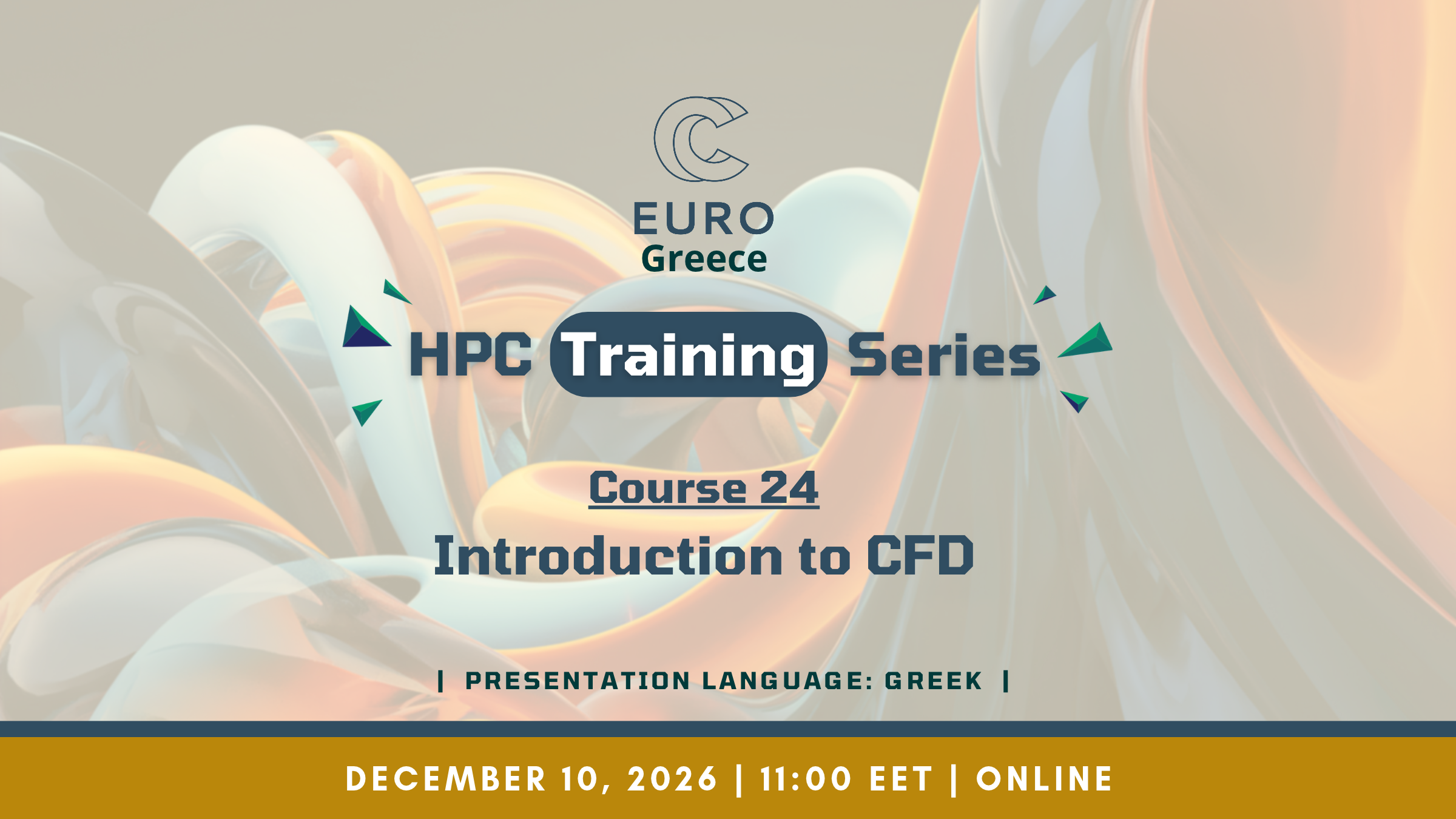
EuroCC@Greece announces the 24th Course of HPC Training Series with the subject "Introduction to CFD".
Date: December 10th, 2026, at 11:00 - 14:10 EET
Location: Online via Zoom
Presentation Language: Greek
Audience: This course is intended for CFD engineers, academic researchers, and technical university students interested in performing CFD simulations.
Course Description:
This course introduces the fundamentals of Computational Fluid Dynamics (CFD), covering the complete simulation workflow, from mesh generation to post-processing, the selection of appropriate CFD models based on accuracy and computational requirements, and an overview of commonly used CFD software tools.
Learning Objectives:
By the end of the webinar, participants will be able to:
-
Understand the complete CFD workflow, from mesh generation to post-processing and analysis of simulation results.
-
Identify and distinguish between different CFD models based on their accuracy, computational complexity, and HPC resource requirements, and select the most appropriate approach for their needs.
-
Recognize the main differences between commonly used CFD software tools.
Prerequisites: Basic understanding of fluid mechanics.
Instructors’ Short Bios:
-
Prof. Varvara Asouti is Assistant Professor in the School of Mechanical Engineering of the National Technical University of Athens (NTUA). She is with the Lab of Thermal Turbomachines and the Parallel CFD & Optimization Unit of NTUA. Her research interests include the development of CFD-based analysis and optimisation methods for internal and external aerodynamics, including both adjoint & evolutionary algorithms, as well as the use of AI/ML in fluid mechanics and/or multi-disciplinary applications.
-
Dr. Xenofon Trompoukis obtained his Ph.D. from the Parallel CFD & Optimization Unit (PCOpt) of the School of Mechanical Engineering at NTUA in 2012. During his doctoral studies, he contributed to the development of an in-house, GPU-accelerated CFD software and its integration into a multidisciplinary analysis framework. Since then, he has been working as a Research Officer at PCOpt/NTUA. He has participated in several EU-funded research projects focusing on the development and application of CFD and optimization methods in HPC environments, with particular emphasis on adjoint-based multidisciplinary optimization.
-
Dr. Dimitris Theodoropoulos is an affiliated senior researcher at the Institute of Communication and Computation Systems (ICCS) of the National Technical University of Athens, Greece and the Microprocessor and Hardware Laboratory (MHL) at the Technical University of Crete, Greece. In 2003 and 2005 he obtained his Diploma (5-year degree) and M.Sc degree respectively from the Electronic and Computer Engineering department at the Technical University of Crete, Greece. In 2007, he joined the Computer Engineering department of the Delft University of Technology, the Netherlands, and in 2011 he was awarded his Ph.D. Between 2011-2019, he collaborated with the Telecommunication Systems Research Institute at the Technical University of Crete, Greece, and the Computer Architecture and VLSI Systems group at the Foundation for Research and Technology – Hellas (FORTH) in Crete, Greece.
Note: Please enter your institutional/corporate email when registering.
At any time, you can request the Withdrawal of your consent by sending to marcomms@grnet.gr the documents “Form of Withdrawal of Consent” (Registration) and “Form of Withdrawal of Consent” (photos/videos) found at the bottom of this page.
---

EuroCC 3 has received funding from the European High-Performance Computing Joint Undertaking (JU) under Grant Agreement No. 101306701. The JU receives support from the European Union‘s Digital Europe Programme and Germany, Albania, Austria, Belgium, Bosnia and Herzegovina, Bulgaria, Croatia, Cyprus, Czechia, Denmark, Estonia, Finland, France, Greece,Hungary, Iceland, Ireland, Italy, Latvia, Lithuania, Luxembourg, Malta, Montenegro, the Netherlands, North Macedonia, Norway, Poland, Portugal, Romania, Serbia, Slovakia, Slovenia, Spain, Sweden, Türkiye, and Kosovo.
Funded by the European Union. Views and opinions expressed are however those of the author(s) only and do not necessarily reflect those of the European Union or EuroHPC Joint Undertaking. Neither the European Union nor the EuroHPC Joint Undertaking can be held responsible for them.